









The University of Kentucky Air Force ROTC held a field training exercise at Hisle Park on Thursday morning to test their grit and survival skills.
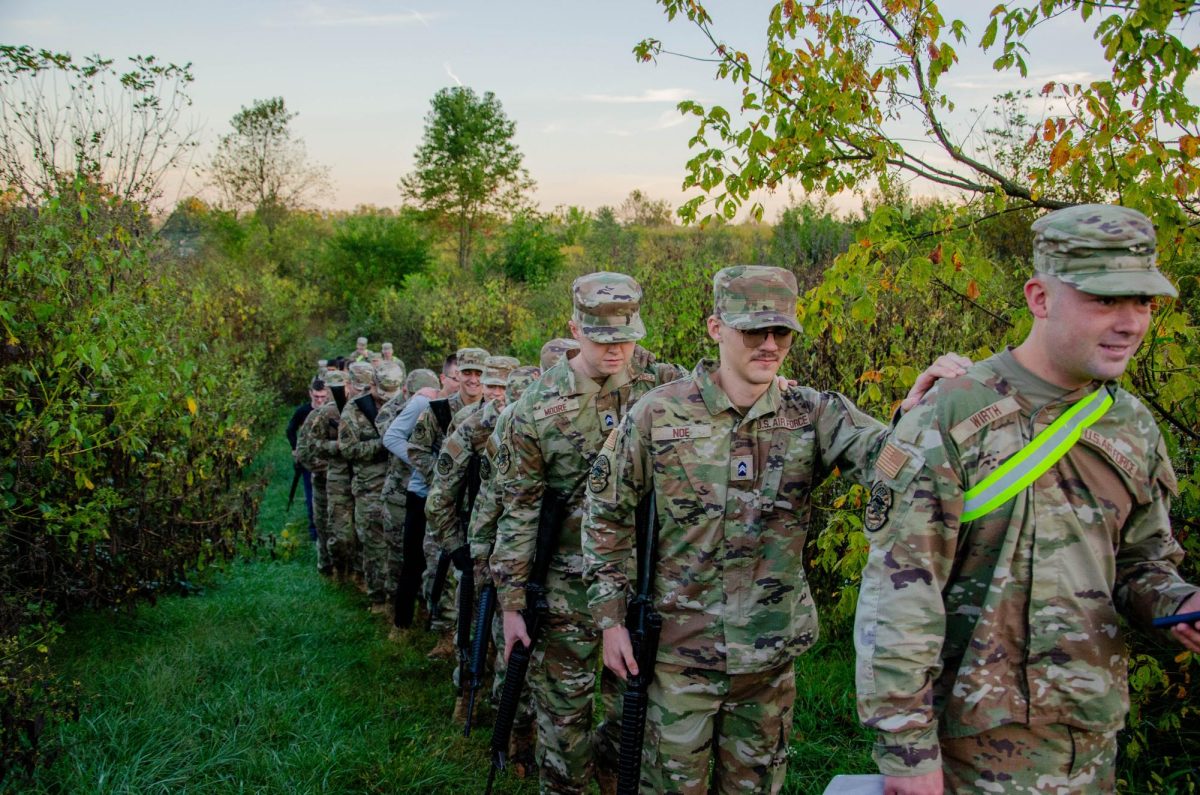
At Hisle Park, cadets carried rubber rifles they had nicknamed “rubber duckies” to simulate real-life combat that they might face once they commission as officers. UK upperclassmen led this exercise to analyze and give experience to the freshman and sophomore cadets. This was also an opportunity for those being watched to show off their skills and leadership abilities.
They utilized the training they’ve learned since being in the program in preparation for a day full of crawling in mud, shouting commands and performing medical procedures on downed airmen. Cadets demonstrated proper gun handling safety to ensure everyone stayed safe and responsible.
“These guns feel real. I feel myself getting tired of holding these things in a couple hours,” UK freshman William Mitchell said.
Cadet Mitchell later led a group of cadets to secure an objective deep in the woods.
Many cadets were still waking up and expressed their lack of sleep and hunger due to the early wakeup call. Cadet William Whitfield was one of the first on the scene, utilizing his phone light to see in the dark and obtain accountability of his flight.
“I can never get any sleep before lab. It’s like the night before Christmas,” Whitfield said.
Cadets from all years woke up as early as 4 a.m. to start their long day. Transit started from Barker Hall at 6 a.m., where cadets arrived at the park before sunrise, causing the use of headlamps.
As the rest of Detachment 290 arrived at the park, the sun started to rise, and everyone formed up into their respective flights. From here, the flights broke up into groups and performed “Group Leadership Projects” where cadets work to solve a common goal.
These projects were created to intentionally put cadets under stress, seeing how they’d perform in such an environment. Upperclassmen often act as the adversaries in these scenarios to combat the younger cadets and cause confusion in their chain of command.
One of the cadets in charge was UK senior Braydon Mefford, who acted as an overseer to the entire project. He works to ensure that all learning requirements are being met.
“We are not out here to have fun, cause this may very well save your life someday,” Mefford said.

